> ## Documentation Index
> Fetch the complete documentation index at: https://elementary-devin-1782754750-bigquery-permissions-docs.mintlify.site/llms.txt
> Use this file to discover all available pages before exploring further.
# Splunk
Elementary's Splunk integration enables streaming audit logs and system logs directly to your Splunk instance via HTTP Event Collector (HEC) for centralized log management, monitoring, and analysis.
## Overview
When enabled, Elementary automatically streams your workspace's [audit logs](/cloud/features/collaboration-and-communication/audit_logs/overview) ([user activity logs](/cloud/features/collaboration-and-communication/audit_logs/user-activity-logs) and [system logs](/cloud/features/collaboration-and-communication/audit_logs/system-logs)) to Splunk using the [Splunk HTTP Event Collector (HEC)](https://docs.splunk.com/Documentation/Splunk/latest/Data/HECExamples). This allows you to:
* Centralize all logs in your Splunk instance
* Set up custom alerts and dashboards on log events
* Correlate Elementary logs with other application logs
* Perform advanced log analysis and search using Splunk's powerful query language
* Maintain long-term log retention in Splunk
## Prerequisites
Before configuring log streaming to Splunk, you'll need:
1. **Splunk Instance** - A Splunk Enterprise or Splunk Cloud instance with HTTP Event Collector (HEC) enabled
* HEC must be configured and accessible from Elementary's servers
* You'll need the HEC URL (e.g., `https://splunk.example.com:8088`)
2. **HEC Token** - An HTTP Event Collector token for authentication
* You can create a token in Splunk under **Settings > Data Inputs > HTTP Event Collector**
* The token must have write permissions
3. **Splunk Index** (optional) - A specific index where logs should be stored
* If not specified, logs will be sent to the default index configured for the HEC token
## Configuring Log Streaming to Splunk
1. Navigate to the [**Logs**](/cloud/features/collaboration-and-communication/audit_logs/overview) page:
* Click on your **account name** in the top-right corner of the UI
* Open the dropdown menu
* Select **Logs**
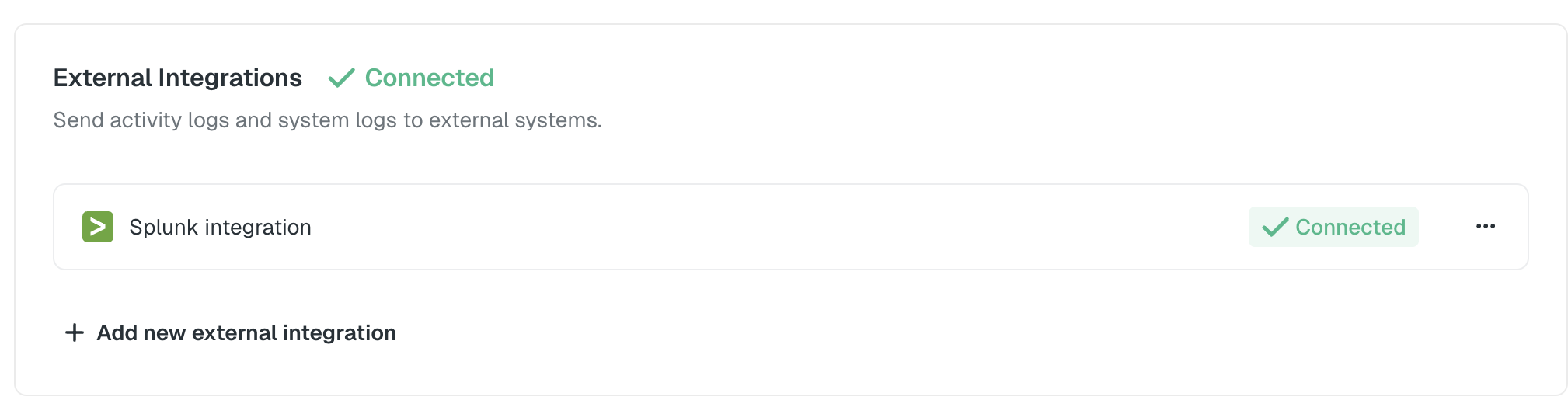
2. In the **External Integrations** section, click the **Connect** button
3. In the modal that opens, select **Splunk** as your log streaming destination
4. Enter your Splunk configuration:
* **HEC URL**: Your Splunk HTTP Event Collector URL (e.g., `https://splunk.example.com:8088` or `https://example.splunkcloud.com:8088`)
* **HEC Token**: Your Splunk HEC authentication token
* **Index** (optional): The Splunk index where logs should be stored (defaults to the token's configured index if not specified)
5. Click **Save** to enable log streaming
The log streaming configuration applies to your entire workspace. Both user activity logs and system logs will be streamed to Splunk in batches.
## Log Format in Splunk
Logs are sent to Splunk with the following structure:
### Event Structure
Each log entry is sent as a JSON event with the following fields:
* `event`: The log data as a JSON object
* `sourcetype`: `_json` (indicating JSON format)
* `source`: `elementary-cloud` (identifying the source)
* `time`: Unix timestamp of the event
* `index`: The Splunk index (if specified in configuration)
### User Activity Logs
Each user activity log entry includes:
```json theme={null}
{
"timestamp": "2024-01-15T14:30:45.123456Z",
"log_type": "audit",
"event_name": "user_login",
"success": true,
"user_email": "john.doe@example.com",
"user_name": "John Doe",
"env_id": "env_7890123456abcdef",
"env_name": "Production",
"event_content": {
"additional": "context"
}
}
```
### System Logs
Each system log entry includes:
```json theme={null}
{
"timestamp": "2024-01-15T14:30:45.123456Z",
"log_type": "system",
"event_name": "dbt_data_sync_completed",
"success": true,
"env_id": "env_7890123456abcdef",
"env_name": "Production",
"event_content": {
"environment_id": "env_789",
"environment_name": "Production"
}
}
```
### Field Descriptions
* `timestamp`: ISO 8601 timestamp of the event (UTC)
* `log_type`: Either `"audit"` for user activity logs or `"system"` for system logs
* `event_name`: The specific action that was performed (e.g., `user_login`, `create_test`, `dbt_data_sync_completed`)
* `success`: Boolean indicating whether the action completed successfully
* `user_email`: User email address
* `user_name`: User display name
* `env_id`: Environment identifier (empty for account-level actions)
* `env_name`: Environment name (empty for account-level actions)
* `event_content`: Additional context-specific information as a JSON object
## Viewing Logs in Splunk
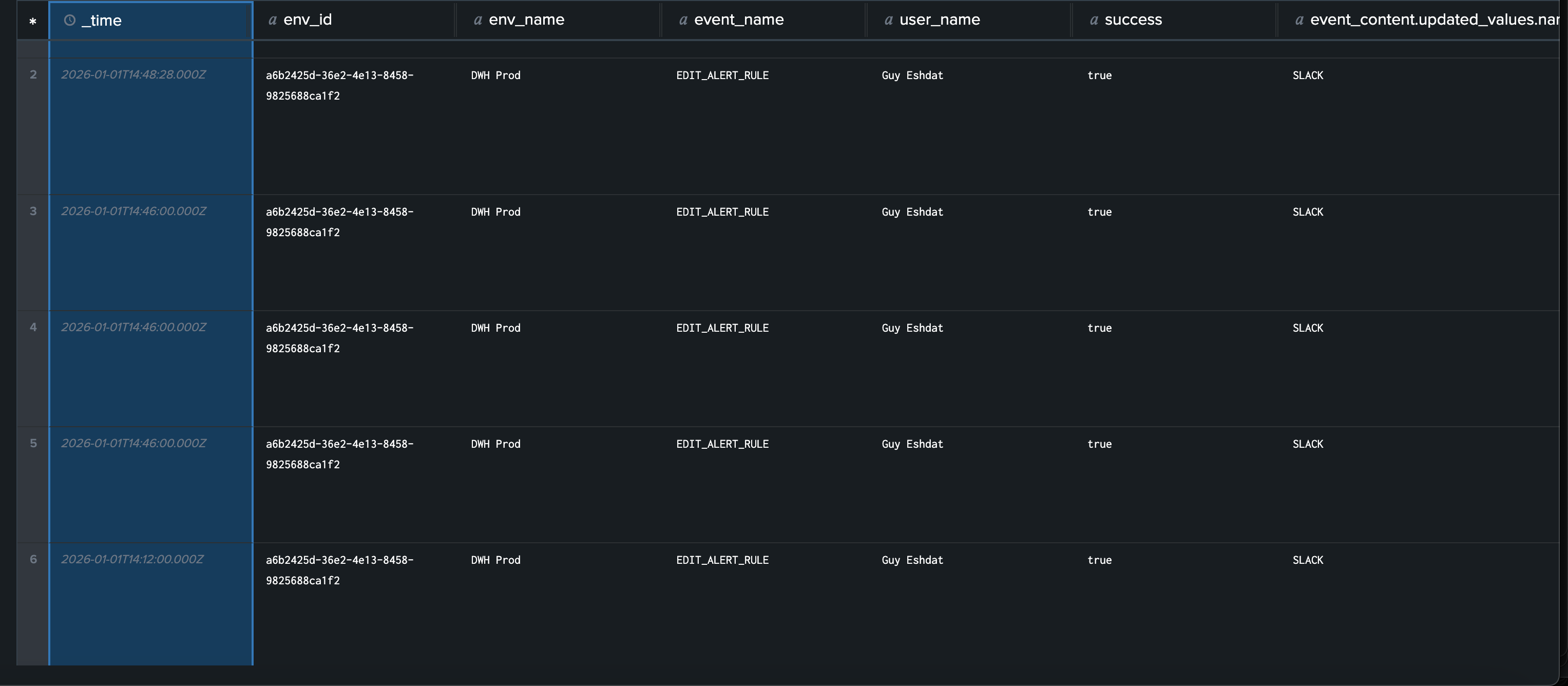
Once configured, logs will appear in your Splunk instance within a few seconds of being generated.
You can search logs using Splunk Search Processing Language (SPL):
```
# Search for all Elementary logs
source="elementary-cloud"
# Filter by log type
source="elementary-cloud" log_type="audit"
source="elementary-cloud" log_type="system"
# Search for specific actions
source="elementary-cloud" event_name="user_login"
source="elementary-cloud" event_name="dbt_data_sync_completed"
# Filter by environment
source="elementary-cloud" env_name="Production"
# Search for failed operations
source="elementary-cloud" success=false
# Search by user email
source="elementary-cloud" user_email="john.doe@example.com"
```
## Disabling Log Streaming
To disable log streaming to Splunk:
1. Navigate to the [**Logs**](/cloud/features/collaboration-and-communication/audit_logs/overview) page
2. In the **External Integrations** section, find your Splunk integration
3. Click **Disable** or remove the Splunk configuration
4. Confirm the action
Disabling log streaming will stop sending new logs to Splunk immediately. Historical logs already sent to Splunk will remain in your Splunk instance according to your retention settings.